
What Percentage of Motorcycle Accidents are Fatal?
Riding a motorcycle can be thrilling. There’s nothing more exciting than feeling the engine rev as you accelerate and the wind rushing past you as you fly down the open road. Still, the joy of motorcycle riding comes with serious risks.
At some point during your riding experience you may have wondered, “What percentage of motorcycle accidents are fatal?” In 2024, roughly 5.3 percent of motorcycle crashes ended in the death of either the driver or the passenger. Around 80 percent of motorcycle crashes result in injury or death. But that number doesn’t tell the whole story. Read on to learn more about how motorcycle accidents compare to other forms of transportation, how fatalities vary from state to state, and broad trends in motorcycle safety.
Motorcycle vs. Passenger Vehicle Fatalities
Though only a small percentage of motorcycle crashes end in death, motorcycle accidents are still around 27 times more lethal than car crashes. To get an apples-to-apples comparison, transportation safety experts at the National Highway Traffic Safety Administration calculate the rate of fatal crashes in two ways:
- Number of registered vehicles: The fatality rate per 100,000 registered motorcycles is 66.89, whereas that of passenger cars is 11.64.
- Amount of miles traveled: The fatality rate per 100 million vehicle miles traveled (VMT) is 31.54. It’s only 1.15 for passenger cars.
Table 1. Motorcyclists Killed and Injured in Traffic Crashes, and Fatality and Injury Rates, 2015-2024
| Year | Killed | Registered Vehicles | Fatality Rate per 100,000 Registered Vehicles | VMT (millions) | Fatality Rate per 100 Million VMT |
|---|---|---|---|---|---|
| 2015 | 5,029 | 8,600,936 | 58.47 | 19,606 | 25.65 |
| 2016 | 5,337 | 8,679,380 | 61.49 | 20,445 | 26.10 |
| 2017 | 5,226 | 8,664,108 | 60.32 | 20,149 | 25.94 |
| 2018 | 5,038 | 8,659,741 | 58.18 | 20,076 | 25.09 |
| 2019 | 5,044 | 8,596,314 | 58.68 | 19,688 | 25.62 |
| 2020 | 5,620 | 8,347,435 | 67.33 | 17,947 | 31.31 |
| 2021 | 6,144 | 9,424,769 | 65.19 | 19,642 | 31.28 |
| 2022 | 6,251* | 9,186,256 | 68.05 | 23,765 | 26.30 |
| 2023 | 6,366* | 9,516,910 | 66.89 | 20,181 | 31.54 |
| 2024 | 6,228* | 9,261,249 | 67.25 | 22,241 | 28.00 |
| Year | Injured | Registered Vehicles | Injury Rate per 100,000 Registered Vehicles | VMT (millions) | Injury Rate per 100 Million VMT |
| 2015† | 88,738 | 8,600,936 | 1,032 | 19,606 | 453 |
| 2016 | 104,442 | 8,679,380 | 1,203 | 20,445 | 511 |
| 2017 | 88,592 | 8,664,108 | 1,023 | 20,149 | 440 |
| 2018 | 81,859 | 8,659,741 | 945 | 20,076 | 408 |
| 2019 | 83,814 | 8,596,314 | 975 | 19,688 | 426 |
| 2020 | 80,662 | 8,347,435 | 966 | 17,947 | 449 |
| 2021 | 84,898 | 9,424,769 | 901 | 19,642 | 432 |
| 2022 | 82,690* | 9,186,256 | 900 | 23,765 | 348 |
| 2023 | 82,567* | 9,516,910 | 868 | 20,181 | 409 |
| 2024 | 86,887* | 9,261,249 | 938 | 22,241 | 391 |
* Starting in 2022, motorcyclists exclude people on motorized bicycles.
† NASS GES and CRSS estimates are not comparable due to different sample designs.
Sources: FARS 2015-2023 Final File, 2024 Annual Report File (ARF); NASS GES 2015; CRSS 2016-2024; VMT and Registered Vehicles – Federal Highway Administration (FHWA). National Highway Traffic Safety Administration, Traffic Safety Facts: Motorcycles, 2024 Data (DOT HS 813 824, July 2026), https://crashstats.nhtsa.dot.gov/Api/Public/ViewPublication/813824
Motorcycles are involved in a disproportionate number of traffic fatalities compared to other types of vehicles. While motorcycles only comprise about 3 percent of registered vehicles and represent 0.7 percent of vehicle miles, motorcycle accidents account for roughly 16 percent of traffic fatalities in the United States each year and 20 percent of all occupant fatalities, including drivers and passengers.
Fatal Motorcycle Crash Trends
In the last decade or so, motorcycle crash fatalities have trended upward at an alarming pace. The number of deaths from motorcycle crashes has grown by around 24 percent in 10 years, but it seems to have plateaued. That figure hit an all-time high in 2023, with 6,366 motorcycle deaths, and fell slightly in 2024 to 6,228. At the same time, the motorcycle fatality rate per 100 million miles traveled decreased by 11 percent due to a 13 percent increase in miles traveled.
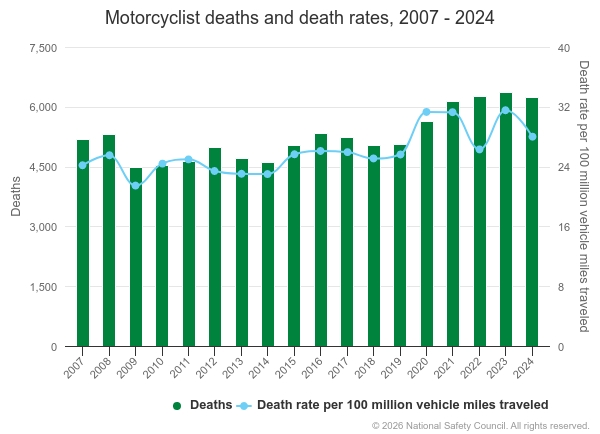
In the same period, trends in passenger vehicle fatality rates were relatively flat. There was a spike following the pandemic, but overall, the per mile fatality rate for passenger vehicles has hovered near historical lows for the past 10 years. Motorcycle crash fatalities have grown as a percentage of the total, while the proportion of non-motorcycle fatalities has declined.
States With the Most Fatal Motorcycle Crashes
Motorcycle fatalities vary from state to state. Factors that can influence the totals include population, traffic enforcement, helmet mandates, registered motorcycle riders, and rates of alcohol use.
Texas is among the top states, both in terms of rate and absolute numbers.
Top Five States for Motorcycle Fatalities (2024)
- Florida: 642
- Texas: 583
- California: 522
- Ohio: 222
- Arizona: 219
Top Five States for Motorcycle Fatalities (per 10k motorcycle riders)
- Texas: 15
- Missouri: 13.1
- District of Columbia: 13
- Arkansas: 12.1
- Louisiana: 12
How Fatal Motorcycle Accidents Occur
The overwhelming majority of fatal motorcycle crashes (approximately 80 percent) are front-end collisions. About 60 percent of fatal crashes are collisions with other vehicles. At the same time, motorcycles are more likely than other vehicle types to be in deadly single-vehicle collisions with fixed objects, such as concrete barriers, guardrails, and poles.
Roughly 24 percent of fatal motorcycle wrecks involve non-vehicle objects versus 16 percent of passenger car crashes, 12 percent of light trucks, and 5 percent of large trucks.
Single-Vehicle Collisions
Motorcycles are more prone to single-vehicle accidents than their four-wheeled counterparts because they’re less stable and more vulnerable to a loss of control.
- Sharp turns: A deadly crash can happen when a rider attempts to negotiate a sharp turn at excessive speeds, causing them to slide and “wipe out.”
- Adverse road conditions: Motorcycles are susceptible to losing traction on roads that are slick or covered in loose gravel.
- Animals: The sudden appearance of dogs, cats, or wildlife in the road is a greater threat to a motorcycle rider.
Multi-Vehicle Collisions
Motorcycles are smaller and less visible to other drivers, so they’re frequently exposed to a greater risk of collision.
- Left-turn collisions: In 45 percent of fatal multi-vehicle collisions, the motorcycle rider was going straight, passing, or overtaking another vehicle when the vehicle made a left turn.
- Both traveling straight: In 20 percent of multi-vehicle collisions, both vehicles were headed straight.
When Most Fatal Collisions Occur
Most fatal crashes happen in the afternoon or at dusk on weekdays.
- 56 percent occur during daytime, 4 p ercent at dusk, and 38 percent after dark.
- 54 percent occur on weekdays, and 46 percent on weekends. However, more crashes happen on Saturday and Sunday than on any given weekday.
Factors that Contribute to Motorcycle Fatalities
Several behavioral and environmental factors can lead to fatal motorcycle crashes, including:
Driving record: Motorcycle riders in fatal accidents were more likely than other types of drivers to have DUIs, license suspensions, speeding tickets, and crashes in the five years before their deadly crashes.
Alcohol use: Roughly one in three deadly motorcycle crashes involved some level of intoxication. In 26 percent of cases, the driver’s blood-alcohol content was over .08 blood alcohol content. About 8 percent of drivers had less than that amount in their systems at the time of the crash.
Speed: High speeds played a role in 37 percent of fatal motorcycle accidents. For passenger vehicle crashes, that figure was only 22 percent. Speed is a greater factor for young drivers. Excessive speeds contributed to56 percent of fatal crashes with riders under 20,
Weather conditions: Inclement weather can lead to motorcycle crashes. Nevertheless, 97 percent of fatal crashes occur in clear conditions, primarily due to the fact that more people are riding motorcycles when the weather is nice,
Riding without a helmet: Helmets drastically reduce rider and passenger deaths, as seen by comparing mortality data between states that do and do not have universal helmet laws. In states without the law, 57 percent of riders who died in crashes had no helmet vs. about 10 percent in states that do.
Licensure: One-third of riders in fatal collisions did not have a valid license at the time of the crash.

Note: Excludes all drivers with previous records that were unknown.
Most Common Types of Motorcycle Injuries
Deaths from motorcycle crashes went down in 2024, the most recent year for which we have data, but the number of injuries increased by more than 5,000 from 82,567 in 2023 to 86,887.
Without the steel frame of a vehicle surrounding them or safety features like seatbelts and airbags, motorcycle riders are vulnerable to danger and risk being thrown off of their bikes onto hard surfaces. Here are some common motorcycle injuries:
- Road rash: When the body skids across the road’s surface, it can cause deep abrasions on the skin, especially if the rider lacks a specialized jacket or other protective gear.
- Broken bones: During a hard collision, the rider may be ejected from his or her bike and break bones from hitting the road, a retaining wall, a vehicle, or another object.
- Traumatic brain injury: A hard strike on the concrete can cause a concussion, brain bleed, or other head injury. Helmets reduce this risk by up to 69 percent.
- Internal organ damage: An impact on the torso can cause internal bleeding and severely damage the lungs, kidneys, spleen or any number of vital organs.
- Spinal injuries: The spine can be seriously injured in multiple ways during a motorcycle crash, through direct blunt force trauma or whiplash, potentially causing paralysis or another permanent disability.
- Testicular damage: Because male motorcycle riders straddle their bikes, testicular injuries are commonly seen in motorcycle crashes.
Contact an Experienced Motorcycle Collision Lawyer
Motorcycles can be a fun way to get around town, but they’re also significantly riskier than other forms of transportation. While the roads have gotten safer in the past two decades, and motor vehicle fatality rates are nearly at an all-time low, motorcycle fatalities and injuries have been trending upward, accounting for a greater share of deadly crashes. It’s hard to attribute this to one cause, but it seems to be a combination of a new group of younger, less experienced riders taking to the road, the lack of universal helmet laws, weak enforcement of licensing, and other factors.
Still, it doesn’t have to be a game of chance every time you climb onto your bike. You can take steps to make every ride safer, like wearing a helmet, watching your speed, and avoiding alcohol when you drive. But even the careful are unlucky sometimes. If you or someone you love has been seriously injured or killed in a motorcycle collision, you may be entitled to damages. Talk to a skilled Austin motorcycle accident attorney at Loewy Law Firm for a free consultation by calling our Austin office at (512) 280-0800.
References and Additional Reading
https://crashstats.nhtsa.dot.gov/Api/Public/ViewPublication/813732
https://www.nhtsa.gov/press-releases/motorcycle-safety-awareness-month-motorcyclist-fatality-rate
https://www.nhtsa.gov/road-safety/motorcycles
https://injuryfacts.nsc.org/motor-vehicle/road-users/motorcycles/
https://www.trafficsafetymarketing.gov/safety-topics/motorcycle-safety
https://crashstats.nhtsa.dot.gov/Api/Public/ViewPublication/813743
https://crashstats.nhtsa.dot.gov/Api/Public/ViewPublication/813466
https://crashstats.nhtsa.dot.gov/Api/Public/ViewPublication/813589
https://www.iii.org/fact-statistic/facts-statistics-motorcycle-crashes
The content on this website is for general informational purposes and should not be considered legal advice. Laws change, and case outcomes depend on specific facts. Viewing this material does not establish an attorney-client relationship. For legal guidance on your specific situation, consult a qualified attorney.